Follow Us on Twitter

What really happened at Bellwether New Jersey

There is a distinct difference from what Bellwether promised the State of New Jersey, it's residents with disabilities and the families who had cared for them the day their child received her first diagnosis. While stories of satisfaction do exist, Bellwether couldn't maintain the staffing to ensure quality in all of its 60 plus facilities.

On June 27th, the New Jersey Record revealed detailed confirmed accounts of abuse cited in State inspections and reviews of the companies community facilities. It was dark.
https://www.app.com/story/news/investigations/watchdog/2019/06/27/bellwether-behavioral-health-group-home-nj-failed-while-collecting-taxpayer-money/1582291001/?fbclid=IwAR0QUbZ74wl3Pe92Gii2EAWaR9-AOCtvbub-cl9E5WuzXbsb9epRt3S2Qsg

What follows is an abbreviated account of the violations documented and confirmed by reporters Kim Mullford, Gene Meyers, Lindy Washburn, and David M. Zimmer. Thank you for your thoroughness and attentiveness to the needs of those without a voice. 

The state found:
  • In Susan's Osborne's chart, it was clearly indicated that her meals be cut into small bites and be observed by staff her during meals so that "she wouldn't stuff her mouth swallow too quickly." These were medical orders entered into Susan's care plan by HER DOCTOR. It didn't make sense that a staff member would neglect these orders. Nonetheless, Susan died May 30th after choking on her meal. It's alleged that three staff members immediately moved to cover-up the cause of her death. A lawsuit filed by Susan's guardians paints a grim picture of her death, the cover-up, and finally the admission from staff that they had not followed her doctor's orders. Bellwether is named in the suit; their response is to blame to the employees. BLAME THE EMPLOYEES? Bellwether hired the EMPLOYEES. Bellwether trained the EMPLOYEES. Susan's death is a shared preventable tragedy for which Bellwether should accept ownership of due to their failure to ensure her safety and care. 
  • Joshua Hays was another resident in Susan's home. At 24, he was challenged by autism and pica. In 2016, Joshua needed surgery to remove indigestible items, including balloons and rubber gloves that he had eaten as a result of his pica. Bellwether, then known as Advoserv, assigned employees to the hospital to observe Joshua's recovery from surgery. During his first 36 hours under the oversight of his "observer," he removed and ingested his abdominal bandages. According to court records, the family settled its lawsuit for $575,000.
  • In May 2017, Carlos Beltre died under what his family felt where mysterious circumstances. His sisters had noticed that Carlos often had injuries during visitation - a split lip, a black eye, and cuts that had been stitched at the hospital. On May 17, one of his sisters received a call that he had stopped breathing. His death certificate states he died from an irregular heartbeat of unknown cause - while in the direct sight of staff. The family is currently litigating the events that led to Carlos's death.
  • A few days later, in another home, Francesca Gregorio, got up in the middle of the night in search of something to eat. The kitchen cabinets were supposed to be locked and Francesca was supposed to be supervised. However, she found an open cabinet and drank a bottle of oven cleaner. After the initial agony, she fell into a coma at the hospital. She's now a resident of a rehabilitation facility where she receives all of her nutrition through a feeding tube. She can no longer walk.
  • In Gloucester County, Lauren Page was punched in the face by a staff member. She had to have surgery to repair her broken eye socket. The employee pled guilty to assault and was placed on 1 year probation. Lauren now suffers from PTSD. 
  • Nicholas Mayer had autism. At a doctor's appointment with his mother, she notices scratches and similar injuries. Nicholas told her that they were from being restrained. When his mother investigated, she found the staff had a code word they used to get Nicholas worked up so that they could restrain him. She reported what she learned to the state. The state confirmed the assertion. 
Next Up: The New Jersey Record Reporters delve deeper.


Category: 0 comments

What was Bellwether supposed to provide? The easy explanation.


This is what Bellwether advertised as their strength: Skimming the children and adults who received the higher rate of reimbursement because of the need to add additional staff to manage them. Only, the staff simply didn't exist. Yet, the homes had to operate. PEOPLE lived there. They were after all HOME to each of the residents. And despite Bellwether's demise, most residents will continue to call these facilities home as outside operators are moving to take over management and staffing of these homes. 

What no one has addressed is how to undue what happened to those residents who lived in facilities that repeatedly failed them. Or how to prevent it AGAIN. Florida, Delaware, New Jersey. 

The legacy continued. By year three Bellwether business in the Garden State was falling to pieces. 


What services did Bellwether Provide?

Category: 0 comments

New Jersey closing its doors to Bellwether

What ever happened to Bellwether/Advoserv/Carlton Palms? I've heard that question often over the last year. From advocacy groups to parent groups, they wonder why the Gingerbread House closed up overnight and went up for sale. Bought by a builder in Delaware, the house will likely stay, but the grounds are in growing residential area where McMansions don't dot the countryside, they are the countryside. 

While Bellwether left Delaware and Florida in a quiet rush, it had already set down roots in New Jersey.

Things didn't go well.

New Jersey was a state with a vast deficit in community based living options. It had been a mandate of the federal government to start moving institutional-based of individuals with developmental disabilities into their communities. Community-based living was a concept that eventually was determined to be a best practice. This required a wide range of homes to meet the needs of varying disabilities. Families who had been over-burdened by the depth of their child's disabilities where also hopeful that a community based setting would help relieve the pressure they bore while improving the quality of life of their loved one. 

In all Bellwether would accumulate 62 homes. However, in New Jersey Bellwether found it harder to play ball. It may have accumulated more homes than any other service provided; however, the company didn't have Ken Mazik's political savvy. Whereas he had deftly handled politicians and moved legislation along to support for-profit homes and to hide deficiencies, Bellwether was simply unable to court policy makers. And I suppose you can only hide so many deaths and accusations of abuse for so long...


On May 28, 2019, Tom Hester, a spokesperson for the State Department of Human Services announced that 9 different operators would assume Bellwether's facilities, residential, and day programs. While residents would not have to re-locate, Bellwether was going into receivership after being unable to sell itself. It was crashing...hard.

Furthermore, there is no guarantee that all of these 9 providers will provide better care. That's due to the enormous staffing shortage. Who wants to work with developmental and intellectually disabled adults when their salary is $11/hour? It's rewarding but exhausting and that pay doesn't always attract the best candidates for the job. It's a national crisis.  


NJ Doors ClosedNJ Doors Closed Tue, May 28, 2019 – A2 · Courier-Post (Camden, New Jersey) · Newspapers.com


Staff Shortage in New Jersey
Staff Shortage in New Jersey Tue, May 28, 2019 – A2 · Courier-Post (Camden, New Jersey) · Newspapers.com
Category: 0 comments

The Tribute to Paige

I had planned to close this blog with a bio of each child or adult identified as dying while in Bellwether's care. When a hedge fund buys a for-profit mental health system, it inherits it's debts, losses, and deaths. The stain transfers one owner to another, although that does not exculpate Ken Mazik's role in the nightmare conditions of the beast he created and from which enriched himself.

Prince Jon was the first known death.

Paige Elizabeth Lunsford
Florida, July 6, 2013

On July 6, 2013, Paige Elizabeth Lunsford died while in the care of Carlton Palms. The story of her death would be recounted in the press multiple times. It was her death that might have put the wheels of closure in motion.

In the days prior to her death, Paige Lunsford vomited "like a waterfall" according to a supervisor at Carlton Palms where the 14 year old with autism resided.

Yet, Paige didn't receive proper medical care or the potentially live saving trek to the Emergency Room at her nearest hospital until she was dead. Her official cause of death was medical neglect and inadequate supervision. That's are far cry from what her death entailed.

"For five days and five nights, Paige Elizabeth Lunsford... wretched like a waterfall, could not eat, and thrashed about in an educational facility staffed with teachers, nurses, and doctors."
Paige's condition was not improving, yet no one called for help. Instead the young teen was placed in restraints, they bound her wrists, ankles, biceps, and waist to try to control her thrashing.  Ten days after Paige was admitted she died of a high fever. The coroner noted that she was severely dehydrated due to an infection - a condition that could have been treated and did not need to end in death. Where was the nurse? Where was the doctor? Why did no one come to Paige's aid as the young girl was strapped into a her death bed? Why did her parents not know how sick she was? They'd delivered a health teen just 10 days prior and Paige was a minor!

At 7 am, July 6th, 2013, Paige's suffering came to an end 
when she went into full cardiac arrest.  


Paige's death became the 140th complaint lodged against Carlton Palms and it's owner AdvoServ in Florida. The investigation into her death found that all but one hour of video surveillance of the child's final day was accidentally deleted. What detectives did see in that one hour was mundane and unremarkable. Paige herself was known to be self injurious. She came to the Palms with a helmet, special arm splints and special clothing to help keep the child from excessively scratching herself. Her medical records notes that her behavior would escalate if she was sick or in pain. When that happened, staff put her restraints although Florida had very strict laws regarding restraints. The protocol for approving restraints for Paige was never initiated. The staff did so without the required guidance and supervision of a nurse and/or doctor. On her final night, she was so ill that she vomited 25-30 times. Medical staff had been contacted multiple times. Yet, no clinician came to check on Paige. And the staffers, in their infinite knowledge, thought Paige might actually be faking her condition - so they took it upon themselves to restrain her to test their theory. Who killed Paige? The whole damn lot of them. 

Tomorrow, Paige's family will mourn their lost child for the fifth year. We did not reach out to the Lunsfords out of respect for their privacy. 

Paige's family members are welcome to contact Echo. 


Category: 0 comments

ONE YEAR LATER

7/4/2019

One year ago, I put Echo Awareness into hibernation. I walked away. I needed a breather. Audrey Quinn's podcast on Bellwether and the developmental mental system had aired with accolades. I was tired. I was traumatized. I was fighting my own battle at home to regain my child with classic autism who had spiraled into a prolonged manic episode. She'd missed almost half a school year because she was unsafe to herself and others. She has a mean a left hook and phenomenal aim. We were desperate and searching for answers for her. We contemplated in-patient treatment, but there were no facilities in Delaware that had an autism unit. Our daughter would be placed with children who cut, who had eating disorders, who were rehabbing from drugs. All things a child with autism would learn without even trying to due to the nature of the condition. She'd be part of group therapy even though she was non-conversational with limited verbal and had slowed verbal processing. Essentially, she falls behind in conversations and when she does share she's usually several minutes behind and her vocabulary is limited. The one facility that evaluated her, the one with worst reputation but one of the only two in-state that treated children with mental and behavioral health needs, denied her admission. She needed more than they could provided. I was grateful. I didn't want to leave my beautiful daughter in place where there was no autism translator. While we were there a patient set a fire in the bathroom and the police came and put the facility on lock-down. We had to be escorted to our car by police.

With a new psychiatrist on-board, (we got booted mid-episode by the premier children's hospital in Delaware and Florida because her bipolar diagnosis came from an emergency room Psychiatrist in a Maryland hospital.) They lied to us about why they couldn't continue to provide her with behavioral health services. It wasn't that we missed appointments, we were dutiful. We weren't difficult parents. We followed instructions to a T. We were told that the hospital was restructuring its behavior health department to imbed pyschs on the units and they would have little time for out-patient visits. In April, we made the journey to the Mayo Clinic in Rochester Minnesota for a second opinion given she had several cases of altered mental status and seizure like behavior that resulted in ambulance transport from school to the same children's hospital that had dumped us. In May as I read the reports from our Mayo visit, I found the real reason. The hospital was upset that the bi-polar dx came from an ER doctor not their own - one in a small little facility that sat in the county seat of Cecil County, MD, 5 minutes from house, and where the last ICT escort took our family b/c we could not de-escalate our beautiful daughter from her dangerous episode.  The irony? Our children's hospital has contracted to operate the Pediatric unit at the hospital where we finally found the bipolar dx and where the doctor put his foot down and said no more speed. That doctor saved our lives. After a year, the contract was severed, and that smaller independent non-profit hospital is now merging with the largest healthcare system in Delaware. Guess that contract didn't work out. The  Mayo papers were "enlightening." In a time when there is a shortage of mental and behavioral health providers, where waits can be six months or more, hospitals are playing kick the can with our special children. Second opinions not welcome.

And from that moment, I knew I needed a break. That break has come to an end. There are some old Mazik oddities to tie ribbons around and the status of Bellwether in New Jersey desperately needs review because sometimes it's easier to watch children and adults die than it is to do YOUR JOB!


Category: 0 comments

New Content Coming!

Category: 0 comments

The Final Decade: Jon Henley

First Victim, Jon HenleyIn 1997, the same year that Au Clair changed its name to Advoserv, the family of Carlton Palms resident Jon Henley received devastating news.

Tuesday, April 8 1997, The Orlando Sentinel published the obituary of St. Thomas resident, the minor, Jon Henley, age 14.  At right is the official published accounting of Jon Henley's death. It is his obituary.

However, in 2015 Heather Vogell and ProPublica published a much more thorough review of Jon Henley's final hours:

First Victim, Jon Henley Tue, Apr 8, 1997 – Page 2 · The Orlando Sentinel (Orlando, Florida) · Newspapers.com
On April 2, Mazik telephoned relatives of a 14-year-old student to tell them the boy had died of an apparent seizure at Carlton Palms. A caller to the state’s abuse hotline a few months later reported that the boy, Jon Henley, hadn’t received immediate medical care for the seizure, and that staff had neglected him. - https://www.propublica.org/article/advoserv-profit-and-abuse-at-homes-for-the-profoundly-disabled
This is a summary of Vogell's reporting of this incident:

While preparing her story, Vogell reached out to Laurice Simmonds-Wilson. Prince Jon Jon, as his family affectionately called him, had been sent to Carlton Palms because his school district in the Virgin Islands was unable to provide the appropriate setting for him. Prince Jon Jon had autism and seizures.  On April 2, 1997, Ken Mazik called his family to inform them he had died as the result of an "apparent seizure." Carlton Palms paid for his casket and the cost of returning his body to the Virgin Islands.

In 2015, through Vogell, Simmonds-Wilson learned for the first time that there had been an investigation in Prince Jon Jon's death. A few months after Jon Jon's death, the state abuse hotline received a complaint - Jon Henley had not received immediate medical care for his seizures and had been a victim of neglect. The investigation found:
  • His roommate reported that Jon Jon was shaking in his bed early in the morning. Staff failed to help him.
  • Jon Jon was laying facedown in his bed. One staffer admitted telling the boy to be quiet because she assumed he was masterbating.
  • Workers were supposed to check on Jon Jon every fifteen minutes. However, he was found at 7:30 am, dead, still lying facedown in his bed.
  • Jon Jon's autopsy revealed that his blood titers for his anti-seizure medication were far below therapeutic levels. 
Yet, Vogell would discover that, "ultimately, despite signs of potential lapses in care, the sheriff's office did not file criminal charges and state investigators closed their inquiry with no finding of mistreatment. The facility faced no repercussions."

Advoserv offered this statement: "Carlton Palms cooperated with the investigations, which found no wrongdoing, and that '[w]hen incidents like this occur, we responsibly address them.'" 

"When incidents like these..." How many had there been? How many were to come?

Simmonds-Wilson would opine differently. Her family had never been notified that an autopsy had been performed on her beloved nephew. According to Vogell, the family felt they had had been deceived. 

"Jon Jon deserved justice. Period."

Category: 0 comments

Carlton Palms, Sensativity Message

Countdown to the end. It wasn't Carlton Palms' finest hours. The documented and confirmed episodes of abuse are consistent with the creation of a beast so large it cannot be contained. One could opine that facility was akin to doctor mills, except these patients didn't leave but for extreme circumstances. And, to be fair, there were families who deeply believed their loved one was receiving the best care possible. It is not our intention to deprive those families of their beliefs or their support for Bellwether. There will  always be two sides to this story. At least. What Echo has attempted to do is capture what is fact. It's been an effort in restraint. There has been no room for leads and rumors that haven't been substantiated through mainstream channels. Often, there has been difficulty getting agencies in Maryland and Florida to acknowledge Requests for Information and Freedom of Information Act requests. The failure of the departments in each state have stymied our research. However, this blog has consistently relied on accounts previously printed in superior publications, written by trained journalists, fact checked with diligence, and ultimately attributed to these writers and publishers. We owe these reporters and publishers a debt of gratitude.

This is our very special episode of Dr. Phil. Our message above is an effort to warn readers that the posts that follows in the next several posts is sensitive. It is heartbreaking. Gut-wrenching. Devastating. It is the most accurate truth recorded publicly to date.

Category: 0 comments

AfterEffect Drops in Seven Days, Have you been listening?

https://www.wnycstudios.org/shows/aftereffect

Aftereffect, hosted by Audrey Quinn, has dropped.

ARE YOU LISTENING?

A New Podcast Series Examining How America Fails People with Developmental Disabilities through the Experiences of an Autistic Man Involved in a Police Shooting

What we've learned so far... 

As Charles Kinsey lay bleeding in the street, we hear his shooter (a police officer) say it was a bad shot, the sniper was aiming for the other man.  The other man? He meant the autistic Hispanic man playing with his toy truck as he sat on the street, seemingly unaware, locked out by his disability? Was he a threat? This is where Audrey Quinn's story begins. 

It was a steamy summer of black lives verses blue lives. Amidst national outrage on both sides of the debate, completely unaware of the color war, Arnaldo Rios Soto left his North Miami group home. He wandered down the street and sat in the road with his toy truck. His caregiver, a black man named Charles Kinsey, went to retrieve him. A motorist mistook Arnaldo's toy for gun and called 911. Police arrived and ordered Kinsey to lay down with his hand up. He complied while cell phone video shows him both pleading with Arnaldo to do the same and yelling to the officers that he is Arnaldo's caregiver. Kinsey is shot in the leg. The sniper calls it bad shot. Audio of that day reveals that the shooter claimed to have aiming for the other man.

Following the shooting, Arnoldo was subdued, cuffed with his hands behind his back, and put in the back seat of a police cruiser for several hours while police worked the scene. No one noticed that with his hands restrained Arnoldo could not perform any of his calming measures - flapping his hands, playing with a toy. Instead, he screamed...for hours, after questioning he was returned to his group home. 

The next day, Arnoldo, having had time to process what happened the previous day, eloped again. He returned to the scene where Kinsey's blood still marked the moment police violence had entered their lives. It was clear that Arnoldo was far more traumatized than anyone had previously assumed, assumptions made because Arnaldo was not conversational. 

Unable to contain his grief, Arnaldo acted out. His group home providers sent him for admission to a psychiatric program where he floundered in a system that lacked a proper placement for him. Arnaldo was kept in the psychiatric unit for more than 30 days as the State of Florida searched for a home for him, again. It seems that Arnaldo had been stuck in a revolving cycle of psych placements and group homes. With Kinsey, Arnaldo's family believed he was making progress.  However, Kinsey - who did survive his injury - would never return to the caregiving field of work.  

Eve
ntually, representatives from Carlton Palms came calling. Arnaldo had a new home, a facility with a history of abuse and neglect. It's Halloween when Quinn first meets Arnaldo. He's dressed as a police officer as are most of housemates. Think about it. Arnaldo had been at the center of a police shooting. He's seen his caregiver injured. He's been cuffed, left in a police car, questioned in a police station, and drawn back to the bloody scene. Did police costumes constitute Aversion therapy? Nah, Carlton Palms just got a good deal on police costumes.

 In episode three, Quinn begins to delve into Arnaldo's past. She learns how his mother fought for a diagnosis and access to education for her son. Quinn discovers that Arnaldo has ahistory of being turfed from one setting to another. She's told that the sweet man before her has a past spotted with violent episodes. Quinn's learning that autism is not just a spectrum but that it has two faces. She's also wading into the adult developmental disability service/support system -underfunded, a patchwork cobbled together, an industry consumed by for-profits seeking the highest Medicaid reimbursements they can attain. Here, restraint isn't an option, it's requisite, as countless substantiated complaints about Carlton Palms confirmed. 

Of particular takeaway for parents of those who are developmentally disabled, Quinn interviews autistic people. Yes, Echo is not using people first language; Quinn's sources do not see themselves as a person with extra baggage; rather, they see their autism as an inherit part of themselves which they value. The dichotomy is startling when the conversation turns to self-direction, a requirement of facilities that receive funding under state Medicaid Waivers. These intuit autistic adults turn self-direction on its head and is cause for even the best parents to pause and consider the amount of authority they expect their special children to exercise as adults. Lack of communication skills does not negate the individual mandate. 

What happens next? What was particularly cruel about the Halloween costume? What is the Baker Act? 


Episode Four drops tomorrow!


Live in Florida or Delaware? Then this podcast should be of special interest to you!
Category: 0 comments

How Carlton Palms Became a Florida Monopoly

Oh, Nina Bernstein!

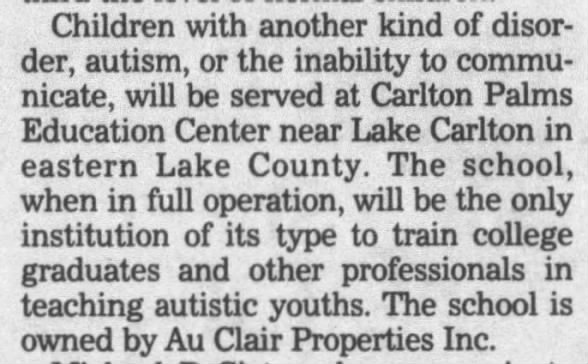
When the welfare reform bill became law in 1997, Carlton Palms was nearly ten years old. It had opened under the premise it would serve 20 to 30 students, as reported at the time by the Lake Sentinel. By 1990, Carlton Palms was serving 48 clients from 28 states.  In 1997, the company, rechristened Advoserv, cared for 120 children and adults in Delaware, New Jersey, and Florida. At its height in 2015, Advoserv would house more than 700 severely disabled children and adults. 

In the late 1990's Au Clair rechristened itself Advoserv. The "new" company began to carefully tread waters in Florida, a full five years ahead of their efforts to stymie reform in Delaware. 


During the following decade, a series of bills were passed in the U.S. Congress following the welfare reform bill that had opened the floodgates of funding for state and federal funding for-profit facilities. 


An unusual event occurred in 2003, perhaps this could have been the first crack in the foundation for Carlton Palms. The State of Florida temporarily cut-off a lucrative voucher funding stream to 21 private schools. Each had failed to submit proper paperwork for various Education Department tuition-voucher programs. Carlton Palms found itself on this list. The affected schools were given to December 15, 2003 to make corrections and resubmit applications. Facilities that failed to comply would not receive their Feb. 2004 voucher payment. -


  •                        -The Orlando Sentinel,
  • 29 Nov 2003, Sat,
  • Other Editions,
  • Page B3


  • However, Carlton Palms rebounded tenfold. 
    Florida began adjusting policies to comply with the new federal mandates and allowances. In 2006, the "legislature statutorily created the Comprehensive Transitional Education Program (CTEP) to serve individuals primarily, though not limited to those with developmental disabilities, who have severe or moderate maladaptive behaviors."   - http://disabilityrightsflorida.org/documents/Carlton_Palms_Report_3-5-18.pdf 

    The intention of the bill was to provide services that were required to be temporary and delivered with the primary goal of achieving principles of self-determination and person-centered planning. The plan was to transition clients to the most appropriate, least restrictive community living program of their choice. That final program of choice could not be operated as a comprehensive transitional education program. CTEP was banned from being the long-term solution. -https://www.flsenate.gov/Laws/Statutes/2018/393.18

    Yet, many who entered CTEP appear to have never left. The only facility in Florida to benefit was Advoserv and its reputation was less than steller. Lobbyists went back to the Florida legislature repeatedly over the next ten years to revise the legislation - winning more beds, more tiers, and more people living together than had been typically allowed nor considered best practices.  With the revisions also came higher Medicaid payments for residents compared to other programs in the state. Money funneled into Advoserv's vast campus', but it's unclear who if anyone funneled out. HIPPA.

    No. That's not true. There are six known victims of Advoserv, aka Bellwether Behavioral Health.  We know they left because they trickled out by ambulance. This may or may not be an exhaustive list.  Given the way records were kept fifty years ago, there may or may not be other victims like John Doe 1998. A resident of Delaware's Au Clair/Advoserv/Bellwether, John Doe died in 1998 after reportedly having seizures. Aside from Delaware's News Journal citing an ambo call and a later correction, efforts to identify John Doe have yet to yield a result. To date, Echo has identified six Bellwether-related deaths, Bellwether legacies:

    1. Paige Lunsford (Florida), 
    2. William James Lamson (Florida),
    3. Jon Hensley (Florida),
    4. John Doe 1998 (Delaware), 
    5. Janaia Barnhart (Delaware),  
    6. Susan Osborne (New Jersey)…
    How did Bellwether manage to have a monopoly in CTEP beds? Heather Vogell of ProPublica unearthed a small caveat imbedded in Florida law. From 2006 to 2015, Bellwether's special status was protected by carefully worded legislation that required the state to contract only with facilities that had obtained their license(s) prior to 1989. Carlton Palms fit that bill with flourish where few other facilities had roots as deep as 1989.


    Bellwether began to feel the winds blowing in a new direction. By 2010, an alarming letter penned by Carlton Palms Director Thomas P. Shea found its way to the parents of his residents.  Shea opined:
    “Both the Florida House and Senate in their efforts to reduce next year’s budget have proposed to reduce the budget by placing a cap for reimbursement for Tier One intensive behavior services for the coming year. The proposed cap is so far below what one could reasonably expect to provide professional, safe, humane, clinical and educational services that we will not be able to serve you and [your child] as of the end of June.” “… We are now at the point of no return for our program’s survival.”
    Despite years of lucrative Medicaid payments, the possibility of caps unnerved Shea. He implored families to sign a petition, attend legislative hearings, and seek out their elected officials to plead on Bellwether's behalf. Legislators received a flurry of "Dear Fellow Floridians" like this one:
    It's not surprisingly that Echo has been unable to locate a public follow-up presser from Carlton Palms regarding the final word on Tier I funding. Yet, it seems the strategy prevailed. The Quarterly Report on Agency Services to Floridians with Developmental Disabilities and Their Costs , First Quarter Fiscal Year 2011/12  (July, August, September) submitted November 2011 shows Tier 1 as having no cap whereas Tiers 2-4 were capped at varying amounts.  
    Again, Carlton Palms escaped unscathed.
    Next: Cartlon Palms, The Final Decade


    Category: 0 comments

    Florida and H. Middleton's Vacation Resort

    Nina Bernstein had opined correctly. For-profit facilities had compromised the care of the children within them. Chronic weaknesses in state regulations had allowed profit-seeking entities to lobby successfully for loopholes and influence. And one man had indeed masterminded a national policy shift without the scrutiny owed to those who would be affected by that policy - the profoundly disabled.

    Heather Vogell would reach the same conclusion in 2015: 
    A deep examination of Advoserv - a veteran industry player now owned by a private equity firm - show how a powerful, well financed provider can exploit a fractured system, using its deep pockets to beat back sanctions, bully regulators and shape the very rules it plays by. - http://www.wmfe.org/how-a-mount-dora-group-home-evaded-regulators-as-abuse-allegations-piled-up/55155
    Harlow Middleton's Vacation Resort dba Carlton Palms II
    • A day later, May 23,1991, The Orlando Sentinel announced the addition of a new face to Au Clair Palms, John J. Mulvena; they noted that the Center's Clinical Director Dr. Judith Favell had been named president of the Association of Behavior Analysis International.

    • There is little to archive about the mechanics of Carlton Palms from 1991 through 2005.  It was a decade of silence, although there are handful of noteworthy tales to share on another day, but none that Echo could find that apply here.  Locals and aficionados, please feel free to leave leads in the comments.
    • Harlow Middleton's Vacation Resort - The Expanded Au Clair/Advoserv/Bellweather Campus

        Next: Florida, Part II


    Category: 0 comments