Follow Us on Twitter

Hide and I will Seek...

Available research shows that Claire Mazik was largely absent from Au Clair after her divorce from Ken. She may have held a 49% interest in the school, but her passion was more for horses than the special needs children being cared for at Au Clair.

However, Ken developed another obsession, growing Au Clair and his empire, and during the 80s and 90s he took the school from being an old horse farm to a massive real estate and equity holding conglomeration.  In 2006, ownership of Au Clair was transferred to entity called Kirkwood Holding Company.  While I haven't been able to pin down exactly when Au Clair became Advoserv, the name change likely occurred in the 1990s or early 2000s.

In fact, Ken had a penchant for playing the for profit system by developing companies that supported other he owned companies, always keeping funding close to home.

Ken Mazik has been a been a principal organization member for 43 different entities incorporated in Flordia:

1. Member - Mount Dora Hospitality Group LLC  (2015)
2. Managing Member - CServ LLC (2014)
3. Chairman and President of Modernism Institute Inc. (Florida) (2013)
  • A rare Mazik Non-Profit
4. Chairman - Modernism Museum of Mount Dora, Inc.  (2013)

5. Managing Member - The Mount Dora Museum Store LLC (2013)
6. Managing Member - Cidget LLC (2013) -
7. Managing Member - Amazik Vehicles LLC (2011) 
8. Managing Member - Mount Dora Lakeside LLC (2010)
9. President - Premier Restoration and Construction, Inc. (Florida) (2009)

10. Managing Member - K&D LLC (2007)
11. Chairman - Forty Acres Holding Company (Florida) (2005)
12. Manager, - Chloe LLC (2005)
13. Manager - BeauClair LLC (2005)
14. President - Cnow Inc. (2002)
15. Director - Mardi Gras of Mount Dora Inc. (1997)
16. Director and Treasurer - J.P. Donnelly Company Inc (1997)
17. Chairman, President, Treasurer, and Director -  Jovius Foundation, Inc.  (1993)
18. Director - Lake Norris Holding Co. (1992)
19. Director - Championship Productions, Inc. (1992)

20. Director - Gilbert Holding Companies (1992)
21. Director - 699 Holding Corporation (1992)
22. Director - Bainum Holding Corp. (1992)
23. Director - Durden Holding Corp. (1992)
24  President, All Care Group Home, #1 (1991)
25. Director - Kizam Corp.  (1991)
26.. President and Director - Orlando Financial Corporation (filed in Florida with holdings only in   Delaware. ((1990)
  • 1701 Shallcross Ave Wilmington, DE 19806 
  • 4185 Kirkwood St Georges Rd Bear, DE 19701 
  • 4185 Kirkwood St Gorges Rd Bear, DE 19701                                                                             
  • 4542 Kirkwood St Georges Rd Bear, DE 19701
27. President, Treasurer, and Director - Florida International Realty Investments (1989)
28. President and Director, Main Street Leasing Company (Florida) (1986)
29. President, Treasurer and Director - Harlem Heights Leasing Company (1986)
30. President, Treasurer and Director - WaterOak Farms Inc (1986)

Inactive
1. President and Director - The Mount Dora Museum of American Fine Arts and Crafts Inc. (2013)
2. Manager - Lake Jem LLC  (2009)
3. Managing Member - 846 Fifth Ave. LLC (2006)
4. Director - Advoserv of Florida (1996)
5. Director - Baker Street Gallery Inc. (1994)
6. Director - Wateroak Holding Corp. (1992)
7. Director - Cox Holding Corporation of Lake County (1992)
8. Director- Lake Carlton Company (1992)
9. Director - All Care Group Home #2. Inc. (1991)

10. Director - 431 Corporation (1990)
11. Director - Carlton Palms Educational Center Inc.  (1986)
12. Treasurer, Director - 431 Donnelly, Inc. (1986)
13. Treasurer, Member - Orange Villas Education Center Inc. (1986)

Precisely 43 different directions to find, vet, and link.  Some might call Mazik a mastermind.  I find him to be an outlier - the right place, the right time, the right opportunities, the right lies. Ken Mazik's success is not a meritocracy. 

 
Category: 0 comments

Chasing Ghosts 1983, Racing into Washington


Despite Mazik's propensity to avoid directly commenting to the press, he appeared to a have a penchant for leaving a trail of breadcrumbs for journalists to follow. (Yes, by this part in the series, we are mixing fairy tales.)

By February 20, 1983, Mazik was again making headlines. The News Journal actually dedicated an entire page to Mazik and his "ventures."  And the name dropping... Stoltzs', DiSabatino, Poppiti, Oh My! Magness, Brooks, and Acierno. OH MY! Mazik had certainly been hobnobbing with some powerful friends and true legacy names in the small state of Delaware.

When his focus should have been Au Clair, Mazik had other perhaps more lucrative plans.  He had enlisted Delaware builder Joseph Capano to invest in a new Harness Racing Track in Washington state. Every potential investor had to be vetted by Washington State's Securities Officer.  Capano didn't pass the vet and was forced out of the money making deal. 

Washington also announced that "Mazik's own personal and financial background" were being investigated. He would eventually pass the vetting and even was hired to sugarfoot the build. But, in the end, the names were just names. He was the only Delawarean to fund the Washington race track.
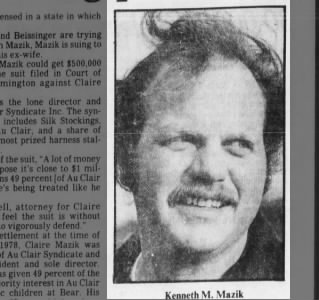
Meanwhile, during this same period of time - two Mazik trainers came forward with claims that he had failed to pay them. His attorney claimed they were owed nothing. However, Mazik, in turn, was suing his ex-wife Clair for a share of the profits in the Silk Stalkings Syndicate. After their divorce, Mazik had purchased Silk Stalkings' 1980 foal for $145,000 and established his own horse syndicate. In Florida, perhaps?
Then there were the rumors that mired the foal, Temujin. Allegations arose that  Joe Capano had been a "silent partner," a violation of the rules set forth by the US Trotting Association. Then it was learned that Temujin had raced twice at Brandywine despite Mazik's failure to register the horse in Delaware - another Trotting Association requirement. 
Clair Mazik, through her attorney, responded to the entire debacle with one particularly precise allegation - Mazik was using funds from the school for personal purchases while failing to declare dividends.  Claire asked the state to put Au Clair into RECEIVERSHIP!

Category: 0 comments

The Sound of Silence

One of the questions The Echo seeks to answer is:  what is the sound of silence?  We urge our audience to bow your heads in a moment of silence for Delaware State Police Cpl. Stephen J. Ballard.


Category: 0 comments

2nd chances are rare. 4th even rarer.

On the racetrack, everyone knows that
only the first place finisher wins the golden purse.
 
 
The story isn't nearly over yet.
 
 
Category: 0 comments

Oz Receives a Reprieve - Earns 1 year License.

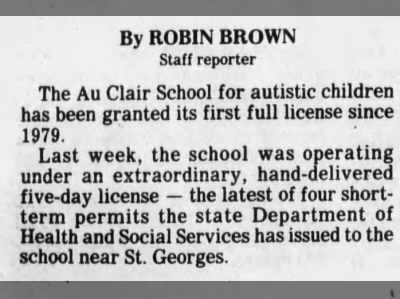
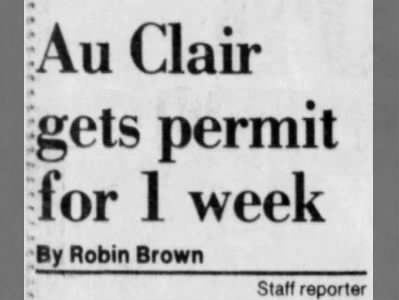
One day before the second license expired, May 15, 1982, it was announced that the school would receive yet one more conditional license - for 30 days.  On June 16, 1982, Au Clair received its fourth provisional license - for five days.  Though more than a year had passed since Au Clair had lost its permanent license, the State of Delaware just couldn't bring themselves to close school. In those last 35 days, Mazik was unavailable for comment because he was in Florida.

And then, on June 22, 1982, it happened -


Oz received it reprieve.
 
Category: 0 comments

The Magical Mazik aka the Wizard of Oz

The Dodgers may have ripped the Phillies and Carter may have promising a new tax package, Delaware's big headline on August 27, 1980 was Au Clair's License Restored on Trial Basis by Charles S. Farrell.

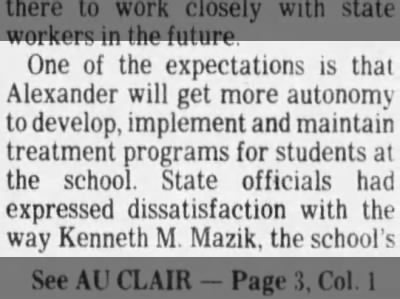
After operating the non-licensed facility for more than a year, Mazik had won a six month Provisional License. The state attributed the concession to Mazik's hiring of an independent Program Manager, Dean Alexander.

Yet, Mazik still wasn't satisfied.  Though he spoke only through his attorney and the parents of his students, his displeasure was evident. It was a demeanor both staff and state department members knew too well.

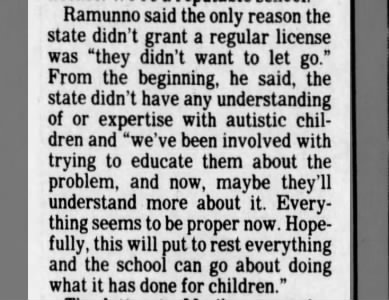
To Rammuno's great dismay, he may have spoken much too soon.  On December 6th, 1980, the Margaret Kirk reported that Mazik's new program manager, Dean Alexander was no longer with company.  He had lasted less than six months. Au Clair espoused that he left Delaware due to a critical illness of a family member in California. 

Mazik quickly replaced him with Leonard I. Sains, a special education-alist out of New Jersey who had made a career out "job hopping" through the special needs industry.  He landed in Delaware, fresh from his executive directorship at The Early Childhood Learning Center of New Jersey. Sains did provide value to Au Clair, he had accumulated tremendous education and experience working with the severely challenged.  He wasn't just a warm body.  When Mazik went to the state in 1981 to request an extension on his provisional license, Sains qualifications scored Au Clair another opportunity to continue to operate.

By 1982, Au Clair was operating on its second conditional license and holding their breath.  One day before the second license expired, May 15, 1982, it was announced that the school would receive one more conditional license - for 30 days.  On June 16, 1982, Au Clair received yet another provisional license - for five days.


Mazik was unavailable for comment.  He was in Florida.


Category: 0 comments

2017 Update: Advoserv Fades into BellWeather Behavior Health

In the four months since Janaia Barhart mysteriously died at one of Delaware's Advoserv homes, the company has rebranded as Bellweather Behavior Health.

Still, that doesn't change history. And some stories simply can't be hidden behind a name change. Fifty cents to any reader who can name the folks in the photo below:

Category: 2 comments

Parents, Professionals, Magic Mazik, and the Long Road to a Conditional License

10/18/1979 NJ - The State's decision to deny Au Clair a license for the second time did nothing to end the controversy or close the school. Several parents began exploring legal action against the state for "unnecessary interference in their children's welfare." While sifting through future articles never produced any evidence that such a suit was filed, it did reveal Au Clair had a long, quiet road yet to travel with several states deeply vested in the outcome.

While Rammano insisted that Ken Mazik would come out fighting, Mazik never made a spoke publicly. He existed quietly in the shadows and let his attorney, his Au Clair parents, his sending states be the official voice of the battle for Au Clair.

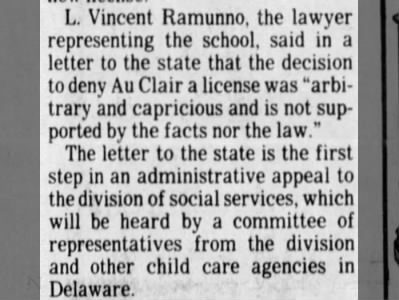
On October 30, 1979, Rammuno filed the first step to an administrative appeal: The Arbitrary and Capricious Clause, defined by Wikipedia as "doing something according to one’s will or caprice and therefore conveying a notion of a tendency to abuse the possession of power." This clause is a legal lynchpin. I knew that before I devolved to Wikipedia as a legitimate source. In most legal administrative procedures appeals can only be filed under these three little words and the filing party is tasked with proving that an action by a public body was "arbitrary and capricious" in order for their appeal to move forward. "Arbitrary and Capricious" is so important to our legal system that it made its way into Title 14, Chapter 1 of the education code that governs our state.

Rammuno also demanded that the state turn over all files so that Au Clair could determine the exact allegations against the school. Finally, in March of 1980, after several negotiations, the state announced that it would reconsider Au Clair's licensing application. Despite losing its license nine months prior, Au Clair had been permitted to continue to operate.  Finally, the school had reached an agreement with the state - it would drop its appeal if the state agreed to re-evaluate the school and the changes that had occurred in the five months previous:
  • The hiring of an independent program director
  • Increased staffing
  • Organized two outside review committees
  • Collaborated with experts on how to improve its program
  • Raised tuition from $18,000 to $26,000 to financially support the new changes to the school's programming.
In return, the state speculated that Au Clair would likely earn a conditional license.  The state continued to have concerns and while staffing and training was strongly stressed, there were concerns regarding the independent program director, Dean Alexander, whom Mazik picked to oversee the school.  At the time of the new review Alexander had only been in the position for a short period of time and while he was highly regarded, the impact of his efforts could not be measured so soon after his hiring.


That should have been the end of the story. 


Category: 0 comments

They may have failed to be licensed...

But, Au Clair continued operating.

The state did not take actions to close the school.
Category: 0 comments

The Bells Before the Knell

*All Newspaper Clips in this Blog Series are Attributed to the Archives at the News Journal, where you, too, can purchase a one month membership for access to Journal related papers dating back to the 1800s. http://delawareonline.newspapers.com/?tpa=ZgmgrjZB3AJIJY7Ba7t93Q%3D%3D

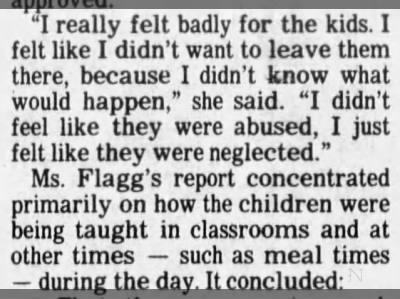
Three days before Mazik would learn his efforts were far short of the state's expectation, another unrelated investigation was concluding concerning the care at Au Clair.  Inspectors from New York had once again deemed "the school grossly inadequate" in a preliminary report released to the News Journal by the NY Department's legal affair office.  On Sept. 30, 1979, the Journal released exerts from interviews with one of the evaluators.

New York had cited Au Clair for:
  • Failing to have enough teachers at the school
  • Failure to hire certified teachers
  • Failure to maintain an appropriate group to teacher ration
  • Failure to have enough school supplies and materials to properly educate the students
  • Finding that students would sit idle for up to 40 minutes while the staff worked with other students
  • Failure to employ health and physical experts
  • Failure to have developed long-term plans for students (a NY requirement but not a DE requirement.)
  • Failure to involve parents in individual program planning
  • A requirement in contradiction with the New York/Au Clair contract for care: Parents were being required to make additional payments for medical checkups and other care beyond the $18,000 the State of New York was already paying.
  • Failure to have a speech therapist - even though their descriptive materials claimed they did.
One of the two investigators, Ms. Flagg, noted that Mazik gave no indication that the school was operating without a license, only that he had applied for one. And for the second time in as many year, New York would delist Au Clair.

Mazik did not reply to requests from the News Journal for comment.
Category: 0 comments

October's Death Knell

On October 4, 1970, The New Journal ran another Au Clair story:  Au Clair School is Again Denied A State License, by Margaret Kirk.  Kirk had been the first to report on Au Clair in July and had with the beat for months, dogging Mazik for an interview he refused to give.

On October 3rd, the state had rejected Mazik's plan and his lawyer, Rammuno, announced he would appeal the decision. "I think now Mr. Mazik will take off his gloves, and come out fighting," he declared. Mazik still refused, though, to talk to Kirk.

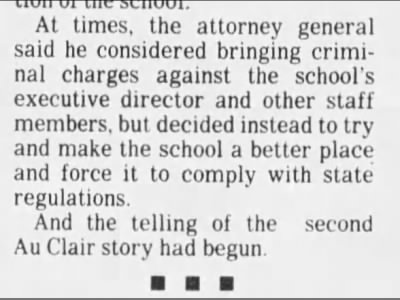
The state had based its decision on finding that Mazik had failed to correct six of the seven deficiencies cited the previous June in the facility's first licensing rejection report. It was found that
  • Mazik made not made a "good faith" effort to hire a program director
  • He had failed to create adequate control procedures
  • He had not developed an outside review committee for the school
  • Little new training had been developed for staff
  • Staffing levels had increased, however, the state questioned the qualifications of several new staff members
  • Minimal changes had been made to the way that aversive - painful punishments - would be deployed with students.
In sum, the state felt that Mazik had not taken its June report very seriously. Mazik had 30 days to file an appeal.
Category: 0 comments

Do Parents Know? Part 2

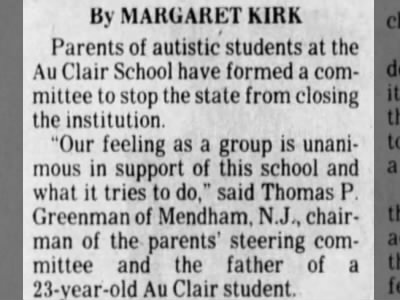
For months Ken Mazik, along with his attorney Vincent Rammuno, fought for Au Clair's license.  Mazik's parents stood staunchly behind him.  But, some wondered if these parents really knew the whole story - the details that the state's report had omitted.

From the News Journal, November 11, 1979:


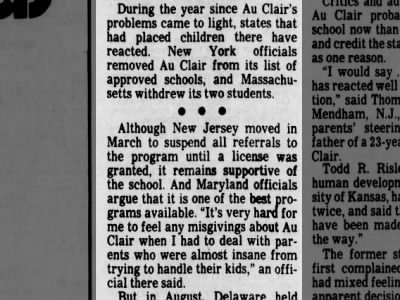
On August 7, 1979, The News Journal reported that Massachusetts had made plans to withdraw their two students from Au Clair and move them closer to home, despite the wishes of at least one of two parents..  Au Clair begged that state to not disrupt the students' lives through such a huge transition.  MA responded that if they arrived at Au Clair, they likely would not find a facility that met their standards. They justified their reasoning by explaining that new facilities that could meet these children's needs had been established closer to their families.

From the News Journal, August 16, 1979:
Mazik was feeling the pressure.  Through his attorney Rammuno, the possibility of appealing the original report was frequently mentioned.  Yet, Mazik was unapologetically working to meet the requirements that the state had laid before him if he wanted Au Clair to continue operating.  However, Mazik and the state were struggling with one requirement - the hiring of an autonomous program director to "formulate, direct, maintain, and implement therapy programs. (NJ 8/7/79). Rammuno represented Mazik as afraid he would loose control over his program.

By August he had provided the state with a report that he believed addressed their concerns.  Mazik claimed to have hired additional staff and was in the process of setting up individual therapy plans for each child/resident. He also offered emergency procedures for the "use of strong punishment only under specific circumstances." The state felt that fidelity to the emergency procedures was the lynchpin to Au Clair's license.

The state in turn reached out to the three independent evaluators, who had helped craft the original report that resulted in the license denial, to evaluate Mazik's plans.

The News Journal reported on September 14, 1979, of a most unusual meeting between state education officials and Matthew L. Israel, president of the Behavior Research Institute Inc. in Providence R.I. to discuss, of all things, opening a special program for Delaware's own children with autism.  Israel's schools were based on the same theories implemented at Au Clair including painful aversives. Israel was as controversial as Ken Mazik, but in a turn of events, the public learned that two of Delaware's children were residing in Israel's care in R.I.  The state was paying $44,000/yr in tuition. And just like Au Clair, Israel's R. I. school had been removed from New York's list of approved providers - for questionable practices around the use of painful punishment, although Israel was touting reinstatement. Mazik, it appeared would also earn its status back.

Meanwhile, attorney Rammuno continued to publicly bemoan the state's process and the very long wait for a verdict on the liscening documents. 
 
Category: 0 comments

Do Parents Know? Part I

DO THE PARENTS KNOW? PART I 
  
Throughout 1979, Au Clair's presence in the New Journal was a phenome, a beacon to reporters who sought headlines and column inches long before the "clicks" of today. One of the headlines that struck me came from the opinion pages, "Do the Parents Know?" It's a piece I intend to reprint. It's author turned out to be a very special person to me - a woman I considered a specialist when my own child began her autism journey. I was deeply stunned when I realized her connection to Au Clair and even more deeply touched to understand how passionately she cared for children with autism. If I had only known the beginning of the story, she and I might have sparred far less often than we did in those early years.
 
When I was inspired to pivot my blog away from education politics in general, I knew I wanted to delve into the past, into the parts of the story that happened before me and before my generation of writers and bloggers.  It's often said of the bible that it's mostly stories, especially the old testament - written by writers who knew how the story ended, but had only an oral tradition of how the story started. They just weren't there to record the beginning and begats. In college, under Dr. Flynn, I had the privilege of taking the Bible as Literature I and II - where my 12 years of Catholic education finally paid off and where I was finally able to contextualize the stories which had influenced me as a child.
 
Because of journalism, of the voracity of readers and the proliferation of reporters in the last 50 to 100 years, we have at our finger tips something that the writers of the bible lacked.  We have the beginning. As a result I could drive the date back all the way to 1969 when two newer-ly weds opened a home for children with the kind of autism that no one wanted and power forward 48 years to the day Janaia Barnhart was killed at Au Clair or as its known today, AdvoServ. 
 
On September 22, 2016, Secretary of Delaware's Department of Education, Steve Godowsky sent the following missive to the districts and charters.  It is the first and only reference of its kind thus far to indicate that there is a Delaware State Police Investigation into Janaia's death.  


While we wait to learn more, I will be plugging away through 1979 and onward to Florida, where Au Clair began its next chapter of abuse as well as digging into how one operation became the unofficial national lobby of for-profit care of those in need of educational and residential placement.


Category: 0 comments

The Final Voices in the News Journal Five Day Expose (1979)

*All Newspaper Clips in this Blog Series are Attributed to the Archives at the News Journal, where you, too, can purchase a one month membership for access to Journal related papers dating back to the 1800s. http://delawareonline.newspapers.com/?tpa=ZgmgrjZB3AJIJY7Ba7t93Q%3D%3D

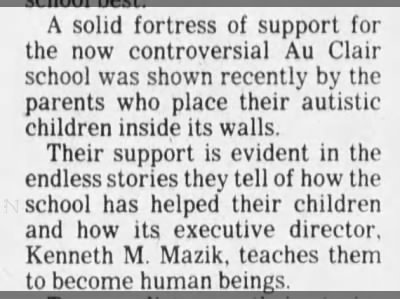
There were still voices who owned the right to contribute to the Au Clair saga.  The first, the children, whose the manifestations of their disability left them sadly silent.  The second, their parents, 30 families in sum, clambered for their opportunity to tell their stories and why they stood behind Ken Mazik and Au Clair despite the atrocious state report and license denial. On July 23, 1979, these parents had their very public say when the News Journal ran their interviews.

When Claire and Ken opened Au Clair they chose one particular population with which to work - those diagnosed with Kanner's Syndrome - which the Mazik described as the most severe form of autism, the children no other facility wanted.  These children were his niche. And for his families, he was their savior.

One New York father told of how Mazik had found his son in another facility, "crouching in the corner of a bathroom." He was naked and covered and feces.  In his son's 10 years at Au Clair the father had never found any sign that his child had been beaten or abused. The father was so impressed that he was already taking steps to move from his home state to Middletown, Delaware.
 
Other stories were more complicated, but gained the same support for Mazik and Au Clair. And each worried about how Delaware's report would affect their own state's view of Au Clair. Would the subsidies stop coming as had happened in New York 1978?

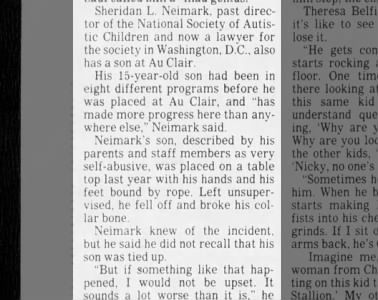
One of the more surprising supporters was autism advocate Sheridan Neimark, former director of the National Society of Autistic Children, whose own son lived at Au Clair.


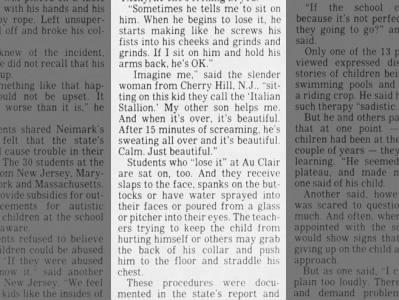
 One after another, parents shared their experiences with her children and attributed successes to Au Clair:


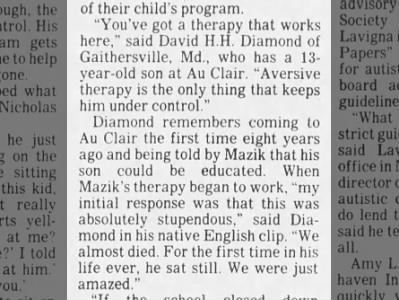
And another:
 
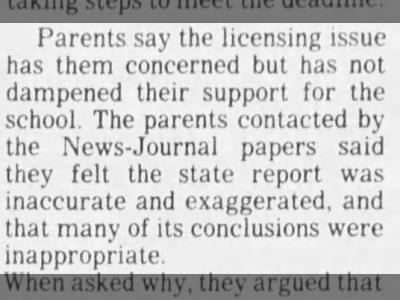
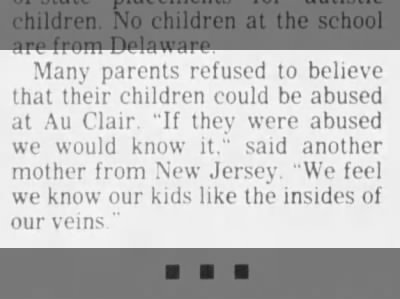
Of the 13 families that the News Journal interviewed only one expressed dismay with the content of the State's report, finding the contents of the report "sadistic."  Some felt that many of the children after certain number of years had plateaued at Au Clair. But, none questioned Ken Mazik.  One parent put this way, "I couldn't complain too loudly. There is a supply and demand problem for these schools. In this case [Masik] can throw my child out on a whimsy."

Several parents questioned the report, especially the fact that they were not contacted when investigators substantiated abuse.  Shouldn't the state have notified them that their children were in harms way? Delaware hadn't reach out to them at all, even though these parents believed knew Au Clair much better than the bureaucracy that was attempting to regulate the school. 

Regardless, Au Clair was the end of a long search for many families, despite the aversives and plateaus, because Mazik had offered them something far better than they'd found elsewhere - hope. And hope is almost as good as home.
Category: 0 comments

Poppycock? Part II, The State's Failure to License

*All Newspaper Clips in this Blog Series are Attributed to the Archives at the News Journal, where you, too, can purchase a one month membership for access to Journal related papers dating back to the 1800s. http://delawareonline.newspapers.com/?tpa=ZgmgrjZB3AJIJY7Ba7t93Q%3D%3D

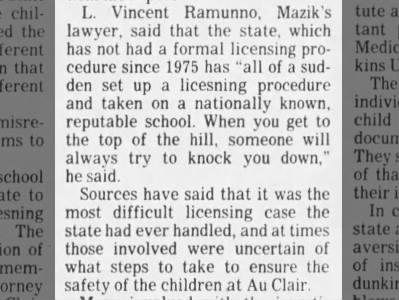
By most accounts, Mazik attorney, Vincent Rammuno hit a homerun when he called out the state on its failure to perform its duties in the licensing of Au Clair.  It wasn't just a deflection point. 

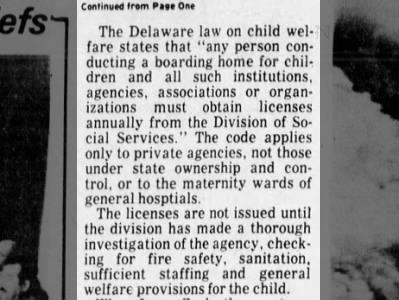
On November 4, 1978, The News Journal ran a story airing the state's failure to maintain licensing practices from 1975 to 1978. The Division of Social Services clearly owned its fault in falling far short of the law with its inability to provide annual licenses to private residential care facilities for children, placement agencies and group homes. The fall-out of these violations had extended to each of the 28 agencies under the purview of the department, putting each facility in tenuous position of operating outside the law, impeding their ability to acquire malpractice insurance, and for some, hindering the ability to receive national accreditations or outside funding.

One facility operator put it this way, "It was a dangerous period for the state and for the consumer - which in this case, the consumer being the child."

By the time the story made headlines, the Division was taking its own corrective action - after realizing its failure put at risk thousands of dollars in federal funds meant to support 150 children who were then placed in these private facilities.


Was it possible that the State was at fault for the deficiencies at Au Clair? On July 25, 1979, the News Journal delved into the ramifications of the state's lapse in licensing at Au Clair.  It's license had expired September 15, 1976.  During its investigation, the News Journal claimed that at least one report of child abuse in May 1978 had been improperly handled because no licensing staff existed at the time. 

Writers pondered whether more instances of abuse would have been uncovered had the school been monitored in the years it operated without state oversight. It was during these years that former and current staff believed that conditions at Au Clair were most critical.

On July 22, 1979, the News Journal ran another story on Au Clair, highlighting the concerns of current and former staff members who had been at Au Clair during the years it was without a license. Some spoke publicly, other asked to have their identity concealed. 

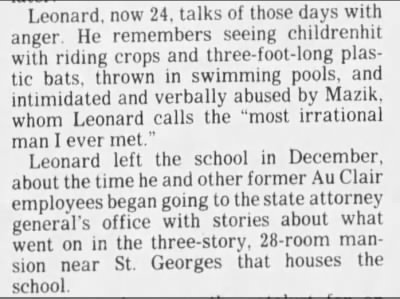
One such staff member was hired into the school in 1977.  He witnessed children being hit with riding crops and a three-foot-long whiffle ball bat.  Another staff member, hired in August 1976, on his second day, witnessed a teen who was tied with a rope around the waist and then dunked into a pool "that had not been cleaned, and it was filled with algae, dirty water, and dead insects."
In 1976, Mazik did admit to using a riding crop on a student. He described the incident as "a long time coming." He justified whipping the 16 year old b/c he " was feeling his manhood" and had begun obsessing about sex.  Suffice to say, he beat the boy's manhood right out of him.  And then there was "Pete's Room."  The room, used at night, had four beds and frequently housed up to six children.  The window in the room was enclosed in a wire cage and the door could be shut and locked.  Staff members were concerned not by the overcrowding, but by the unventilated room temperature which could rise to 95 degrees in the during the summer.

Questions were also raised about the three states that sent children to Au Clair for private placement. How much or how little oversight had these states provided when choosing to send students to a facility without a license.
  • The State of New York had proactively removed Au Clair from its list of approved facilities in 1978 when the school refused to provide enough financial data for the state to justify the cost of care. Au Clair was charging New York $18,000 year per year per child.  In 1979, the only New York students at Au Clair were those who were privately placed by their own guardians.
  • Officials from Massachusetts admitted its last visit to the school was in 1974.   
  • The State of Maryland had made scheduled visits to Au Clair to check on its 8-9 students in residence, however Mazik would not allow surprise inspections.  Maryland would continue to send students to Au Clair/AdvoServ until 2016 when inspectors found deplorable conditions that caused them to sever the contract with the school.
There was just one question looming.  If Delaware had performed its licensing duties would deficiencies been discovered sooner?  It was a question no one could answer. However, one aspect of the case stood out - If Au Clair had been held to the same staffing requirements as public schools, their staffing ratio would have moved from 1:12 to 1:4.

What Au Clair taught Delaware was that it was time to rewrite the state's licensing regulations. 

Category: 0 comments

"It's all Poppycock"

*All Newspaper Clips in this Blog Series are Attributed to the Archives at the News Journal, where you, too, can purchase a one month membership for access to Journal related papers dating back to the 1800s. http://delawareonline.newspapers.com/?tpa=ZgmgrjZB3AJIJY7Ba7t93Q%3D%3D

Mazik immediately assembled his resources calling on parents to come to the school's defense - and they would. He acquired the legal services of Vincent Rammuno, brother-in-law of friend and business partner Joe Capano.  The state's findings? He called them unprofessional. The report? "Scurrilous and the most unprofessional work I have ever seen." The accusations? An assault, the result of his mastermind his ex-wife as a part of their contentious divorce. The sources? Disgruntled current and former employees.  "Poppycock" he called it.

For each allegation, Mazik had an explanation:
*Responses from the July 21, 1979 story on Au Clair, the first in a five day series that delved into the school and its operations.

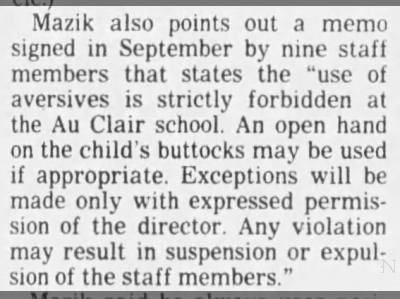
1. The Use of Punitive Aversive Techniques:  In 1979, the use of aversives was an ongoing controversy.  Mazik fell into the old school camp that believe there were times when such punishments were necessary. 
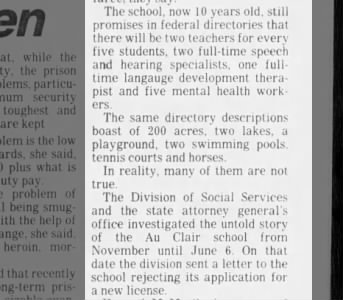
2. Manipulation of the school's computer and video recording system: Mazik claimed to have never misrepresented the schools programs to parents or the public.
3. The fabled Master's degree:  Mazik denied portraying himself as every having one, although that didn't keep him from signing internal documents with MA after his name.  He claimed to have represented himself as having education similar to a Master.
4. The reports of child abuse in 1978: The first spoke for itself. No charges had been filed. For the November allegation, Mazik had a reasonable explanation.  He denied using a belt to punish the student "whom he described as self destructive." Mazik needed to remove him from his top bunk in order to "calm him before he hurt himself." He also claimed that many of the procedures being deemed "aversives" in the report were actually "restraints" used to protect a child from himself.
5. The findings that Mazik failed to comply with regulations over staffing: Despite allegations by former staffers that Mazik was difficult to reach when needed, that he provided little or no supervision, and that the 3rd shift was drastically understaffed, Mazik was unapologetic for what he called "poppycock" and explained that a supervisor was onsite for all shifts. He also claimed that all staff members knew how to reach him.
6. Mazik was unconcerned about the allegations regarding meals as he stated that all children received adequate meals.
7. He blasted the state report for its allegations of over-crowding and explained away the room that housed four beds and six students.  He claimed that there were never more than five students in that room that was infrequently used at night for the more destructive children.
8. As for the state's decision to withhold a new license:
 

Had the state lacked a licensing procedure from 1975 to 1979?  It was an interesting and enlightening turn of events. Perhaps there was some poppycock in play...
Category: 0 comments

The Other Au Clair Story

*All Newspaper Clips in this Blog Series are Attributed to the Archives at the News Journal, where you, too, can purchase a one month membership for access to Journal related papers dating back to the 1800s. http://delawareonline.newspapers.com/?tpa=ZgmgrjZB3AJIJY7Ba7t93Q%3D%3D

The charming, charismatic Ken Mazik was not one for rejection, nor one to be toiled with.  He responded swiftly to state's case against his school calling the state's license rejection "unprofessional" and assembling a panel of parents who were willing (and later would) staunchly and publicly defend the school's approaches as therapeutic and not abusive

But, first, what did the state find? What had lit Mazik's fire?

After an eight month investigation, the state found that Au Clair had been operating in violation of state regulations for programs, staffing and organization of private residential childcare facilities. The list of violations leading to the license denial was exhausting.  The investigators focused their findings in three general domains:

  • The unregulated use of aversive techniques in behavior modifications; 
  • Mazik's own involvement with the school;
  • The lack of staffing and training 

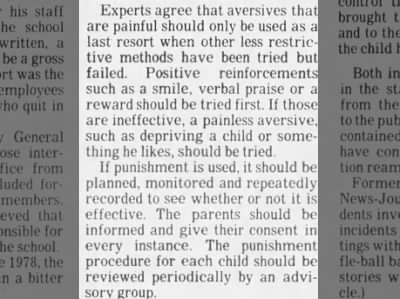
The most contentious finding was the use of aversive techniques to modify a child's behavior. Investigators found that Au Clair used aversive techniques without proper planning and monitoring. Former staff members went on the record calling the techniques abusive and violent. The report cited incidents of beatings, blows to the head, using an instrument to deliver blows, and dunkings in a dirty swimming pool as examples of painful aversives being utilized at the school.
  • The State brought in three independent experts, two from the Princeton Child Development Institute and one from Johns Hopkins,  to review the school.  Each concluded that the use of painful aversive without controlled conditions was a critical deficiency. Within the autism field opinions on the use of punishment to teach children with this disorder were beginning to sway.  Longitudinal data revealed that painful aversive techniques were seldom effective. The conventional wisdom of the time was that such techniques needed to be used under carefully controlled conditions. Au Clair did not have these conditions in place nor any documentation supporting them.
  • Investigators could not find any Individual Treatment Plans for the use of punishment for Au Clair's residents. (There was one exception of the 30 students living at Au Clair.)
  • At least twice in 1978 social service workers were called to Au Clair to investigate cases of child abuse. While no charges had been filed by 1979, the workers findings were the catalyst by Social Services, jointly with the Office of the Attorney General.


  • Both the state and the News Journal independently determined that Mazik's  Masters Degree in Clinical Psyschology from Temple University was a lie.  Mazik fired back that he had only claimed to have similar credentials.  But, that didn't stop him from signing internal Au Clair documents with MA after his name.
  • Former staffers accused Mazik of manipulating the computer and video recording equipment he had at the school.  They claimed that he would have students put on multiple outfits during the course of the day, taping after each wardrobe change.  When parents came to visit and review the tapes, he portended that these were recordings made over multiple days.
  • In May 1978, a social worker arrived at Au Clair to investigate an abuse allegations that 8 or 9 children had been excessively beaten.  It was determined that there existed evidence of abuse, but not enough to close the school.
  • Officials were called to the school the following November to check on a child who had allegedly been beaten by Mazik over the weekend. The reporter determined that a belt or similar object had been used against the child's back. The child's face was also badly beaten.
  • The state's reported also accused Mazik of failing to fulfill his duties as Executive Director due to frequent absences and failure to communicate with staff.
  • Findings included a lack of staff from 12:30 am to 8:30 am when only one staff member was present at the school to monitor the students. This deficiency lasted for more than a year.
  • The school was also cited for not having enough day-time staffing and when those staff came aboard, they received little training
  • Au Clair was cited for failing to have a person knowledgeable about nutrition planning the facility's menus.
  • Parental consent forms related to care and treatment of children were found unsigned.
  • While each childcare facility is required to provide a single bed for each child, Au Clair was found to have at least one room containing four beds and housing six students.
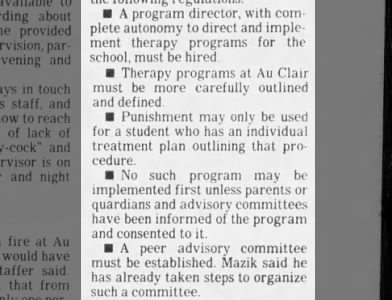
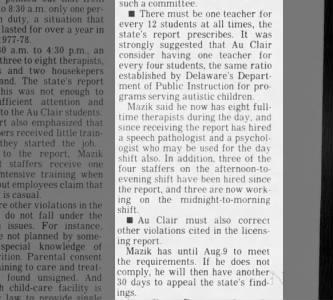
In the end this was what the state required of Mazik to keep his school open:


Next up: The Mazik Response
Category: 0 comments

The Gingerbread House Begins to Crumble

In 1979, the State of Delaware division of Social Services jointly with the Attorney's General's office delved into an eight month investigation of Au Clair culminating with the refusal to renew the school's license. 

The News Journal obtained a copy of the report through FOIA and began its own investigation culminating in a five-day series beginning on July 21, 1979, that told a very different story of Au Clair. On that day, the Journal deemed their findings "the other Au Clair stories, ones not yet told by TV Shows, national newspapers and magazines that made much of the heartwarming tale of the little school and the dreams a horse made come true."  These were the tales of beatings, dunkings, and whippings by riding crop.  Current and past staffers called the role of the horses in the stables nothing more than farce. There were, they said, maybe one or two children who were ever allowed to care for the horses.

Had it all been just a façade? It appeared that the Gingerbread House had begun to crumble.

Category: 0 comments

A Mazik Miracle - Au Clair teaches Champ to Talk

Sidebar:  Champ learns to speak...

In 1973, Au Clair had amongst its residents a youngster named Champ. Champ didn't come to Au Clair with the same classic diagnosis of most of its tenants, Kanner's Syndrom - Ken considered Kanner's his expertise.  Mazik held the opinion that it was the most severe of those conditions that at the time constituted what scientists and doctors knew about Autism and his acquiring physical custody of those children affected with it was part and parcel to the progress he was making in the field.  It was his niche.

Kanner's syndrome

Etymology: Leo Kanner, Austrian-born American child psychiatrist, 1896-1981
a form of infantile psychosis with an onset in the first 30 months of life. It is characterized by infantile autism, with signs of lack of attachment, avoidance of eye contact, and general failure to develop social relationships; rituals and compulsive behavior manifested by a resistance to change and repetitive acts; general intellectual retardation; and language disorders, which may range from muteness to echolalia. Treatment may include psychotherapy and special education, depending on the child's intelligence level. (Mosby's Medical Dictionary, 9th edition. © 2009, Elsevier.)
Champ was not the typical resident by any means, but his presence at Au Clair was immortalized in 1973 when the Ken commissioned famed artist Charles Parks to sculpt his likeness. 
The lifetime works of Charles Cropper Parks are a Delaware treasure. Just as Frederic Remington reminds us of the American West, Charles Parks represented Delaware, its people, its landscape and its values. Parks had always hoped that one day his vast collection would be housed in a space that would be available to the public. In 2011, that hope became a reality when the Parks family donated approximately 290 of Charles Parks' works of art to the State of Delaware. - See more at: http://www.legacy.com/obituaries/delawareonline/obituary.aspx?pid=160668101#sthash.9GUDLIgT.dpuf
Champ doesn't talk
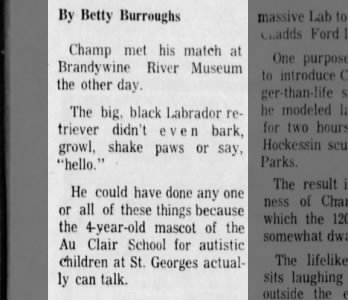
On Tuesday, July 24, 1973 Delaware's Morning News reported on  Ken and Claire's star pupil.  The week previous a small group had set out on a field trip consisting of Champ and three of his classmates. You can imagine it is must have been a pretty upbeat ride to the Brandywine River Museum in Chadds Ford for such a special occasion - the sculpture's unveiling. Ken knew a reporter would be waiting for him and this was his time to shine, his opportunity to justify the sensational costs of private pay care for children at Au Clair. This was to be a story about his feats and not that of the famed Silk Stalkings that seemed to dominate every news story that carried the Mazik name

As well it should have... except Chance had nothing to say.

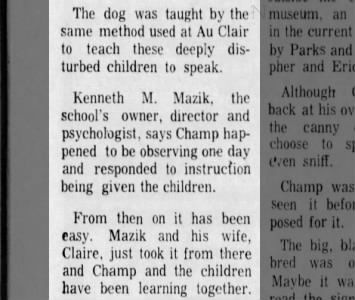
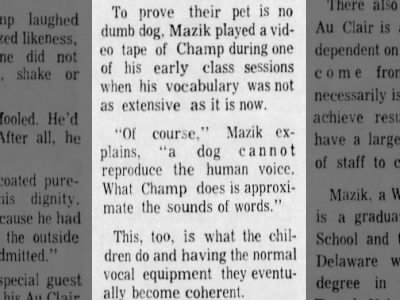
If you haven't guessed it already, Champ was not a student of the two-legged vatiety.  He was the Au Clair mascot.  A "big, black Labrador retriever" whom Mazik claimed he'd taught to talk.  Not bark, whine, or whimper.  But, straight up human guttural words.  Champ was the Mazik Miracle whose skills out-performed those of the fellow students who accompanied him to the museum. Champ was his validation. 


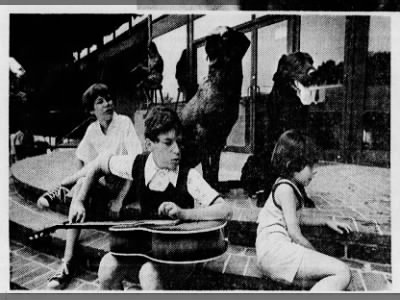
Champ and Fiberglass Statue along with his Au Clair pals.


And to think, in just a few short years, Au Clair would be on the verge of being closed by the State of Delaware.
Category: 0 comments

Update: Things we learned today about how government work...


And sometimes you hit a wall that you can't get over, under, or through... There's this wall that I have yet to conquer - FOIA DENIED. Yet, where there's a will there is a way:

Thomas and her lawyer, Julia Arfaa, say that Delaware officials have stymied their efforts to secure basic information. The state attorney general’s office told Arfaa that, while a police investigation was ongoing, it would not allow release of a recording of workers’ call to 911. “Releasing the 911 tape at this time could potentially jeopardize the investigation, because the call contains potentially sensitive information,” said Carl Kanefsky, spokesman for the attorney general’s office. The office will decide whether to file criminal charges after law enforcement agencies have finished their investigations, he said. A Delaware medical examiner refused Arfaa’s request for initial autopsy findings. Last week, a spokeswoman for the medical examiner said it has not completed the autopsy and will notify Janaia’s family when it does. Delaware state police won’t elaborate on the circumstances of the girl’s death or even release her name.
“We’re blocked,” Arfaa said.  https://www.propublica.org/article/camera-shoving-match-group-home-worker-before-teenager-heart-stopped

Time to reach out to Julie Arfaa. 
 
-----Original Message-----
From: Hudson, Wendy L (DSHS) (DSHS)
To: montagnebeau
Cc: Ivory, Sharon L (DSHS) (DSHS)
Sent: Tue, Dec 20, 2016 10:42 am
Subject: FOIA request - Division of Forensic Science Request for the Autopsy Report of Janaia Barnhart
Good Day –
 

This email is to acknowledge that the Delaware Department of Safety and Homeland Security (DSHS), received your Freedom of Information Act (FOIA) request on Monday, December 19, 2016.  You requested:   The Autopsy Report of Janaia Barnhart Death was September 14, 2016.  Autopsy reports are handled by the Division of Forensic Science, under the Department of Safety and Homeland Security (DSHS).  Please note that FOIA allows access to “public records,” unless the public record requested falls within one of the enumerated statutory exemptions. See 29 Del. C. §10002 (definition of “public record” and specific exemptions); 29 Del. C. § 10003 (setting forth FOIA request procedures).


The autopsy report that you have requested is not a “public record” within the meaning of Delaware’s Freedom of Information Act, 29 Del. C. §§ 10001-10007 (“FOIA”).  Delaware law is clear that post-mortem reports prepared by the Division of Forensic Science pursuant to statute are investigative files that are exempt from the definition of a public record under FOIA.  See Att’y Gen. Op. 15-IB13; Del. Op. Atty. Gen. 05-IB16.  The Medical Examiner is not required to disclose information regarding death investigations to the  public.  See Op. Att’y Gen. 15-IB13; 29 Del. C. §10002(l)(3) (exempting from disclosure “[i]nvestigatory files compiled for civil or criminal law-enforcement purposes including pending investigative files . . . .”).  Upon completion of any criminal investigation, the statute permits the release of reports solely to the next of kin.  See 29 Del. C. §4707(e).

 
The Department considers your FOIA closed, 12/20/16.
 
Thank you.
 
Wendy
 
Wendy Hudson
Chief of Communications
Delaware Department of Safety & Homeland Security
Office of the Secretary

Office: 302-744-2680
 
Fax: 302-736-9184
 
 
 ----------------------------------------------------
Remember when I told you that the Au Clair/AdvoServ story was more complicated than I ever imagined?  That it splits into 42 different directions? And maybe more... For each lead, I have a million documents to dig through. 

Have you ever done a Media Freedom of information Request from the State of Delaware for an Autopsy? While it sounds morbid, it's less so, when you contextualize it.


I have filed my first - for the Janaia Barnhart's autopsy.  Janaia died in September in an AdvoServ residence.  To date, other than the initial reports, the News Journal - basically Delaware's only resource for local news - has not followed up on her story.  That might have to do with their firing of all their experienced journalists in the months after Janiai died (no relation, just correlative.) Or maybe the Journal doesn't care that a 15-year-old with a disability, placed in a Delaware facility by the State of Maryland who had since put the provider on probation and was ending its contract with said provider due to the results of a surprise visit by state officials, might have been murdered by her for-profit caregivers.  Or maybe this is the Howard High story all over again - a young lady is attacked and the manner of death is an undiagnosed heart condition that just happened to be triggered by the brutality but causation is not the actual violence perpetrated on her.

Or perhaps, the jury is still out. 

What do I know?  That some excellent questions may be answered by what the pathologist found while performing Janaia's autopsy. 
 
This is the initial response I received:

-----Original Message-----
From: DGIC (MailBox Resources)
To: montagnebeau
Cc: Hudson, Wendy L (DSHS) (DSHS)
Sent: Mon, Dec 19, 2016 8:44 am
Subject: Re: FOIA request

I’ll forward your email to the FOIA coordinator for the Department of Safety and Homeland Security.
 
Safety and Homeland Security?  I think I just put myself on the no fly list. It's ok.  I am terrified of planes anyway.
 
Elizabeth Scheinberg is a full-time mom, frequent autism advocate, and sometimes freelance writer who often is consumed by her passion for those without a voice.
Category: 0 comments